HowETFsTrade.com

Clear explanations of ETF market structure for investment professionals.

Practical, mechanics-first notes on ETF liquidity, trading, and capacity—written for people who actually allocate capital.

By Will Lee, CFA, CAIA, FRM

What is this?

ETFs are widely used but often poorly understood at a mechanical level.This site exists to explain how ETFs actually trade—where liquidity comes from, how spreads form, why capacity constraints appear, and what changes during periods of market stress.The focus is not performance or product promotion, but market plumbing—explained clearly and precisely.
Free explanations

Selected notes are available publicly to clarify common areas of confusion.

  • Why ETF liquidity ≠ AUM

  • Why ETFs surface liquidity constraints faster than mutual funds

  • Why ETF spreads widen in volatile markets

Optional Updates

New modules are published periodically.If you’d like to be notified when a new explanation is released, you can subscribe below.

DisclaimerThe content on this site is provided for educational and informational purposes only. It does not constitute investment advice, a recommendation, or an offer to buy or sell any security.All views expressed are the author’s own and do not represent the views of any employer or affiliated organization.


Why ETF Liquidity ≠ AUM

ETF liquidity is often misunderstood. A common assumption is that an exchange-traded fund with higher assets under management (AUM) is automatically more liquid than a smaller ETF. While this intuition is widespread, it is incorrect—and can lead to poor trading, portfolio construction, and risk management decisions.ETF liquidity is not primarily determined by AUM. It is determined by market structure, specifically how ETFs connect secondary market trading with the liquidity of their underlying securities.Understanding this distinction is essential for anyone who allocates to, trades, or explains ETFs professionally.

ETF liquidity is often misunderstood. A common assumption is that an exchange-traded fund with higher assets under management (AUM) is automatically more liquid than a smaller ETF. While this intuition is widespread, it is incorrect—and can lead to poor trading, portfolio construction, and risk management decisions.ETF liquidity is not primarily determined by AUM. It is determined by market structure, specifically how ETFs connect secondary market trading with the liquidity of their underlying securities.Understanding this distinction is essential for anyone who allocates to, trades, or explains ETFs professionally.


Why ETF Liquidity Is Often Confused with AUM

The confusion largely comes from how investors think about individual stocks. In equity markets, liquidity is often correlated with market capitalization and trading volume. Large-cap stocks tend to trade more easily than small-cap stocks, so size becomes a reasonable proxy for liquidity.That logic does not translate cleanly to ETFs.ETFs are not operating companies. They are investment vehicles that hold baskets of underlying securities. Their liquidity profile depends less on the size of the wrapper and more on the liquidity of what sits beneath it.As a result, ETF AUM describes how much capital is invested, not how easily additional capital can move in or out.


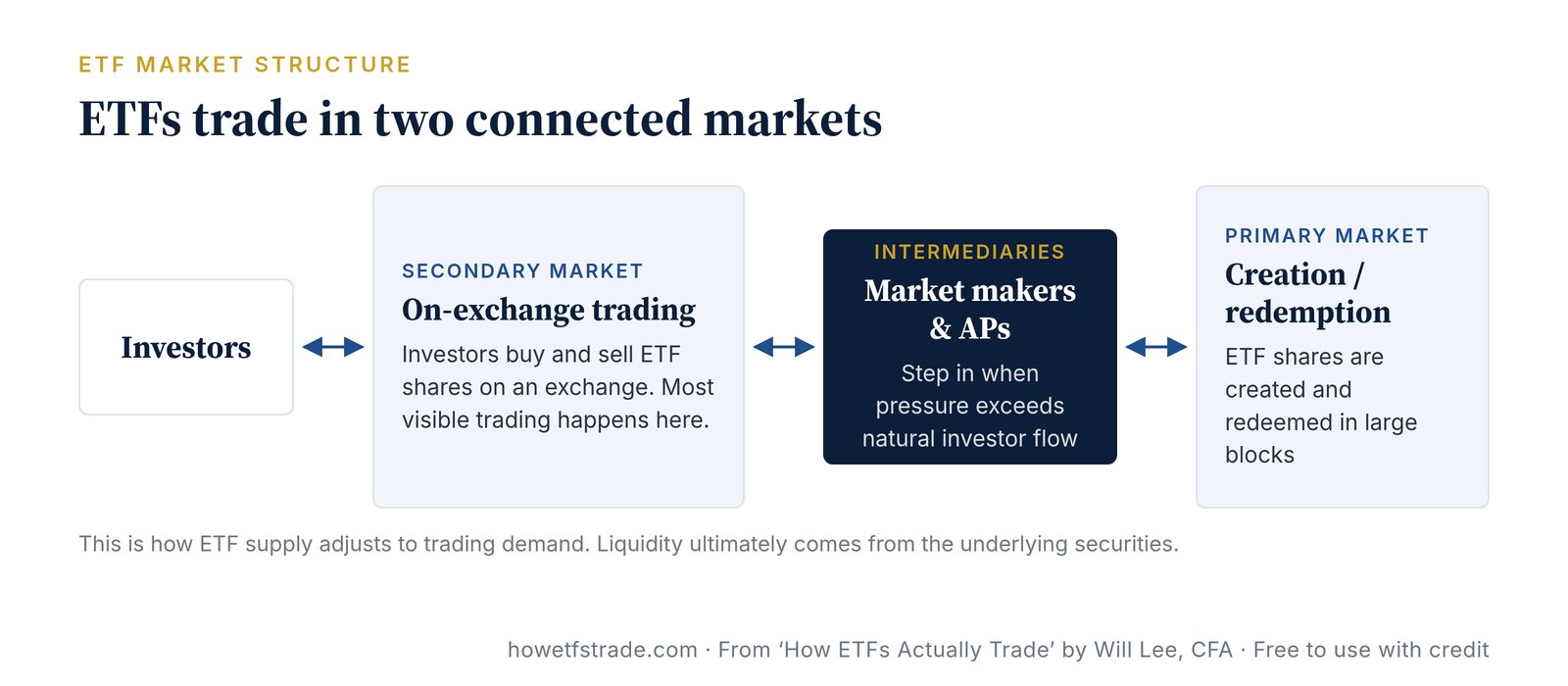
ETFs Trade in Two Markets

A key concept in ETF market structure is that ETFs trade in two distinct but connected markets:

  1. The secondary market, where investors buy and sell ETF shares on an exchange

  2. The primary market, where ETF shares are created and redeemed in large blocks

Most visible trading activity occurs in the secondary market. However, when buying or selling pressure exceeds natural investor flow, intermediaries step in and access the primary market.This is how ETF supply adjusts in response to trading demand.The implication is critical:ETF liquidity ultimately comes from the liquidity of the underlying securities, not from the number of ETF shares already outstanding.


Why AUM Is a Poor Measure of ETF Liquidity

AUM reflects accumulated investor capital. It does not reflect the ETF’s ability to handle incremental trades.For example, a relatively small ETF that holds highly liquid large-cap equities may be able to absorb very large trades with minimal market impact. Conversely, a large ETF holding less liquid assets—such as high-yield bonds or thinly traded international equities—may face tighter liquidity constraints despite its size.In this sense, AUM measures scale, not capacity.Using AUM as a proxy for liquidity can therefore lead to incorrect conclusions about execution risk and tradability.


Why Secondary Market Volume Can Be Misleading

Average daily trading volume is another commonly used liquidity metric. While volume matters for execution planning, it is still an incomplete indicator.

  • Low ETF trading volume does not necessarily mean low liquidity. It may simply indicate that:

  • The investor base is largely buy-and-hold

  • Trading demand is episodic rather than continuous

As long as the underlying securities are liquid, Authorized Participants can create or redeem ETF shares as needed. This allows ETFs with modest on-screen volume to accommodate large trades efficiently.Secondary market volume describes how often an ETF trades—not how much it can trade.


The Role of Market Makers and Authorized Participants

ETF liquidity depends on intermediaries that connect ETF trading to the underlying markets.Market makers provide liquidity in the secondary market and hedge their exposure using the underlying securities. Authorized Participants can transact directly with the ETF sponsor to create or redeem shares when imbalances arise.Their willingness to do so depends on factors such as:

  • Underlying market liquidity

  • Volatility

  • Hedging costs

  • Correlation within the ETF basket

These participants focus on risk and execution, not on ETF AUM itself.


Why ETF Liquidity Appears to Change During Market Stress

During periods of market volatility, ETF bid–ask spreads often widen. This is sometimes interpreted as a failure of ETF liquidity.In reality, ETFs are reflecting changing conditions in the underlying markets:

  • Higher volatility increases hedging risk

  • Balance sheet constraints tighten

  • Underlying liquidity becomes more uncertain

ETFs do not create these conditions—they transmit them. In many cases, ETFs make liquidity dynamics more visible rather than worse.


Implications for Portfolio Construction and Trading

Confusing AUM with liquidity can lead to several practical errors, including:

  • Avoiding smaller ETFs that are fully capable of handling institutional-sized trades

  • Overestimating the safety of large ETFs in less liquid asset classes

  • Treating trading volume as a hard constraint rather than a starting point

  • Misinterpreting spread behavior during volatile markets

A more accurate assessment of ETF liquidity focuses on:

  • The liquidity of the underlying securities

  • The structure of the ETF basket

  • Primary market functionality

  • Execution strategy rather than headline metrics


The Core Takeaway

ETF liquidity is not stored inside the ETF.It is accessed through a market structure that links ETF shares to their underlying assets. AUM describes how much capital is invested. Liquidity describes how efficiently additional capital can move.They are related—but they are not the same.


About this site

This explainer is part of an ongoing series on ETF market structure, liquidity, and trading mechanics.
More detailed modules are available for professionals who want a structured, reusable reference.


Why ETFs Surface Liquidity Constraints Faster Than Mutual Funds

When markets become volatile, exchange-traded funds (ETFs) often appear to show stress before mutual funds. Prices move quickly, bid–ask spreads widen, and discounts or premiums to net asset value can emerge. This behavior is frequently interpreted as a flaw in the ETF structure—evidence that ETFs are fragile or that their liquidity is unreliable under pressure.That interpretation misses the point.ETFs are not creating liquidity problems. They are revealing them earlier and more transparently than other fund structures.Understanding why requires looking at how ETFs and mutual funds process liquidity stress differently—not at the level of assets under management, but at the level of market structure.


How Mutual Funds Absorb Liquidity Stress Invisibly

Mutual funds transact at net asset value once per day. Subscriptions and redemptions are processed after markets close, using prices that reflect completed trades rather than real-time conditions.This structure allows mutual funds to delay the recognition of liquidity costs.When markets are stressed:

  • Redemption activity accumulates during the day

  • Portfolio managers meet those flows over time

  • Transaction costs are absorbed gradually

  • Dilution effects may be spread across remaining shareholders

From the outside, the fund appears stable. NAV changes may look orderly. But the liquidity cost has not disappeared—it has simply been deferred and smoothed.The key point is not that mutual funds avoid liquidity stress, but that their structure allows that stress to remain largely invisible until it has already been internalized.


How ETFs Transmit Liquidity Stress in Real Time

ETFs operate differently. They trade continuously on exchanges, and their prices are set by market participants who must manage risk in real time.Market makers quoting ETF prices must consider:

  • Current volatility

  • The liquidity of the underlying securities

  • The cost of hedging intraday exposure

  • The expected economics of creating or redeeming shares

As conditions change, those expectations change immediately—and are reflected in ETF prices and spreads.This means ETF pricing is forward-looking. It incorporates not only what liquidity looks like now, but what it is expected to look like if trading demand continues.Mutual fund NAVs, by contrast, are backward-looking. They reflect executed trades, not the marginal cost of the next one.


The Role of Market Makers and Authorized Participants

The same intermediaries that enable ETF liquidity in normal markets are also responsible for surfacing liquidity constraints during stress.Market makers:

  • Provide continuous two-sided quotes

  • Adjust spreads to reflect hedging difficulty

  • Price in balance-sheet and volatility risk

Authorized participants (APs):

  • Decide when creation and redemption activity is economical

  • Evaluate funding conditions and operational constraints

  • Step back when underlying markets become costly or uncertain to access

When these intermediaries face higher risk or higher costs, they do not hide it. They embed those conditions directly into ETF pricing.This is not a failure of the ETF structure—it is the structure functioning as designed.


Why ETFs Often Look “Worse” During Market Stress

Because ETFs transmit liquidity information immediately, they often appear to behave worse than mutual funds during volatile periods.Prices move first. Spreads widen visibly. Discounts or premiums attract attention.This difference is often mistaken for fragility, when it is actually transparency.But this comparison is misleading.ETFs are compressing price discovery into the present. Mutual funds are distributing it across time.The apparent calm of mutual fund NAVs during stress is not evidence of superior liquidity. It is evidence of delayed recognition.In this sense, ETF prices are closer to a live market signal, while mutual fund NAVs are closer to an accounting result.


What This Means for Investors and Allocators

For professionals evaluating fund behavior during stress, several implications follow:

  • Widening ETF spreads are information, not malfunction

  • ETF prices can serve as early indicators of underlying market stress

  • Comparing ETF volatility to mutual fund stability is structurally flawed

  • Liquidity risk should be assessed at the underlying asset level, not the wrapper

Most importantly, visible stress is not the same as structural weakness. Transparency can be uncomfortable, but it is often more honest.


Relationship to ETF Liquidity and AUM

The same market-structure mechanics that decouple ETF liquidity from assets under management also explain why ETFs surface liquidity constraints faster than mutual funds.AUM reflects accumulated capital.
Liquidity reflects marginal capacity under current conditions.
When markets are calm, this distinction is easy to ignore. When markets are stressed, it becomes unavoidable.


The Core Takeaway

ETFs do not fail under stress—they reflect it.Their intraday pricing and visible spreads make liquidity costs explicit rather than implicit. That transparency can look unsettling, but it provides a clearer picture of market conditions than structures that delay or smooth the same information.


This explanation builds on the same market-structure framework used throughout How ETFs Trade.


In-Depth Module


Why ETF Liquidity ≠ AUM

A structured professional reference on ETF liquidity, market structure, and execution risk


Overview

Assets under management (AUM) are often used as a shortcut for ETF liquidity. While convenient, this assumption is frequently wrong and can lead to poor execution decisions, incorrect risk assessments, and misleading explanations to clients and stakeholders.This module explains—clearly and precisely—why ETF liquidity is not determined by fund size, and how liquidity actually flows through ETF market structure.It is designed as a reusable reference for professionals who work with ETFs and want a correct, defensible understanding of how they trade.


What This Module Covers

This module explains:

  • What AUM does—and does not—measure

  • How ETF liquidity is sourced from underlying markets

  • The relationship between primary and secondary market liquidity

  • The role of market makers and Authorized Participants

  • Why small ETFs can be highly liquid

  • Why large ETFs can face liquidity constraints

  • Why ETFs surface liquidity stress earlier than mutual funds

The focus is on mechanism and structure, not product promotion or trading tactics.


What This Is (and Is Not)

This is:

  • A concise, structured PDF reference

  • Written for professional reuse

  • Suitable for internal training or client education

  • Designed to be read once and referenced often

This is not:

  • A blog post

  • A marketing explainer

  • A trade execution manual

  • Investment advice


Who This Is For

This module is intended for:

  • Portfolio managers and analysts

  • Traders and execution professionals

  • Investment advisors and consultants

  • Product, distribution, and ETF specialists

  • Anyone who needs to explain ETF liquidity accurately

If ETFs are part of your professional work, this module gives you language, structure, and clarity you can rely on.


Why This Is Different from Free Content

Free ETF explainers often describe what happens.
This module explains why it happens, using a coherent ETF market structure.
In particular, this module includes:

  • A 60-second explanation suitable for meetings and client conversations

  • A simple liquidity transmission diagram that anchors the entire concept

  • Clear distinctions between AUM, volume, and true liquidity capacity

The goal is not more information—it is confidence and correctness.


Format

  • PDF document

  • ~15 pages

  • Clean, professional layout

  • No marketing graphics or filler

  • Designed for printing or screen reference


Price

$49 — one-time purchaseIncludes:

  • Immediate PDF access

  • Lifetime access to this version

Future modules will be offered separately or as part of bundles.


About How ETFs Trade

How ETFs Trade is an independent educational project focused on explaining ETF market structure, liquidity, and trading mechanics with clarity and precision.The emphasis is on how ETFs actually function, not how they are marketed.


About the AuthorWill Lee, CFA, CAIA, FRM

Investment professional with experience across asset management, product strategy, and ETF market structure analysis.This material reflects independent analysis and is provided for educational purposes only.


Available as a downloadable professional referenceDownload the full module (PDF)


Disclaimer

This material is provided for informational and educational purposes only and does not constitute investment advice, a recommendation, or an offer to buy or sell any security.All views expressed are the author’s own and do not represent the views of any employer or affiliated organization.

This module is part of an ongoing series on ETF market structure and trading mechanics.

This module is available as a downloadable PDF.